
2025.5 Volvo XC90 review: Stunted Growth

Updated: Jan 14

2026 Volvo XC90 T8 Ultra review by The Road Beat
Words and pictures: Mitchell Weitzman
I had really high hopes for the updated and supposedly improved “2025.5” Volvo XC90, but a week with it left me disappointed—mostly by how much hasn’t changed, and the fact that the few changes made actually verge on going the wrong direction. It’s easy to blindly celebrate Volvo for merely existing as a less pretentious Swedish alternative to the typical German luxury fare, but the fundamental product is plagued by ingredients that have sadly gone sour upon first opening.
Picks
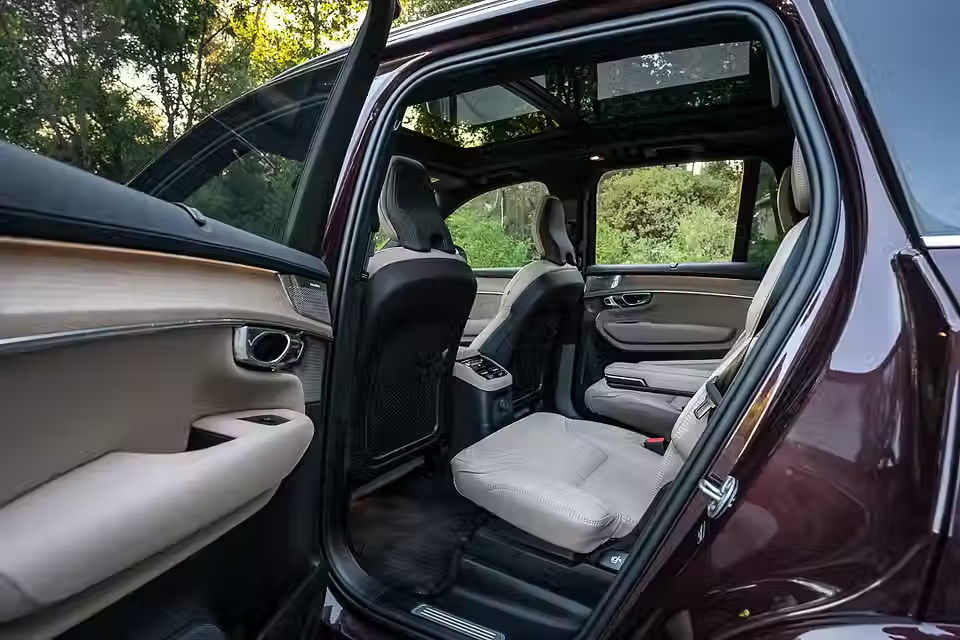
Good news: the XC90 is as pretty as ever. The updated exterior features a sharpened front fascia that looks both thoroughly modern and thoroughly tasteful. The same beautiful interior detailing remains, buoyed by leather and metalwork crafted by skilled artisans and not outfitted by Temu. On the road, it delivers a superlatively smooth driving and passenger experience, with minimal to no wind noise making its way through the body or glass.
Sculpted and leather-clad front seats offer leagues of adjustment—lumbar, bolstering, seat-bottom extension—and some delightful built-in massagers in this test vehicle. Even the seat warmers and coolers prove their worth and border on too effective.
Dominating the dashboard is a huge tablet-like touchscreen with a revamped operating system. Commands are quicker, pages load faster, graphics look fresher, and—finally—you can display both the backup and top-view cameras at the same time, which is extremely helpful for parallel parking or tight maneuvers.

Steering and handling don’t excite, but the XC90 is secure and confidence-inspiring for daily driving. Pick up the pace on a winding road and it doesn’t fall flat on its face, flattering itself with surprising speed and lateral grip. It’s still not as happy as a proper performance SUV from Porsche or BMW M, but it drives more than decently and fulfills its mission as a luxury barge.
When it comes to raw speed, that’s where the XC90 continues to more than surprise. The turbo four-cylinder hybrid of this 'T8' example churns out a combined 455 hp, which absolutely did not need improvement. 0–60 mph happens in as little as 4.5 seconds, though in normal driving the XC90 prefers a relaxed, efficient powertrain response, only summoning the demons when your right foot is buried. As a plug-in hybrid, a full charge of the 18.8 kWh battery nets you over 30 miles of electric-only driving, adding useful commuting flexibility if you have cheap and convenient electricity at your disposal (or even free charging at the workplace). Mixed hybrid driving, however, returned a modest 25 mpg.
Nicks
It might sound like there’s a lot to like, and that’s true. But there’s also a lot that annoys and disappoints—especially considering this was a real opportunity for meaningful improvements from Volvo.

Despite the power, a four-cylinder engine is still a four-cylinder, and it’s just not deserving of a large luxury SUV. When you press the throttle, the noises coming from under the hood are gruff and less than desirable, lacking the smooth rumble or growl of more fanciful six-cylinder units. It’s not a bad engine, but for $90K it’s out of place and undermines the outright glamor. This also has me wondering why Volvo even bothers with combustion at all versus going fully electric for their luxury SUV.
A new screen and UI might be welcome, yet it’s still obviously flawed. Yes, it’s faster—but it’s still slow enough to be annoying for a brand new car with allegedly the latest technology, revealing noticeable lag. Some core interface decisions are baffling, like separating temperature and fan speed for the climate into different digital tabs. Why are those not on the same screen? Other controls are buried, and at times the backup camera refused to show up in reverse—only the top-view camera would appear.

While the overstuffed screen also controls the heated/cooled seats like most modern cars, in order to initiate those lovely massagers you must first press a physical button on the seat just to even bring up the on-screen menu, then the screen takes over - there is zero workaround. Why does one hand need to poke the physical switch while the other immediately taps the screen? It makes no sense and I think many drivers will never know how to start the massagers they paid for. If the screen adjusts the massaging feature, why can't you start them from there, too?
An electronic gremlin hit me when the estimated driving range suddenly zeroed out: miles-to-empty dropped from about 150 to double dashes—zero. The trip computer also freaked out, tanking the average mpg from 24 to… 4. The range eventually returned on its own, but a brand-new car losing and skewing data like that is concerning and goes right in line with my history of new Volvos all having some kind of electronic glitch one way or another.

Enabling cruise control automatically activates a semi-autonomous steering assist by default, and there’s no way to change that after digging through the menus. A quick click of the unlabeled right arrow on the steering wheel disables it, but it seems that you must do that every single time you use cruise. And you will want to, because the steering assist drives like it’s drunk—making small corrections and swerves that will absolutely get you pulled over. If someone can correct me on this being a default, please let me know.
For a $90K vehicle, the third-row seats must be folded and raised manually with no electric assist. Normally I wouldn’t care because I’m not lazy this way, but the real issue is how there’s no convenient pull or latch to use. Once those third-row seats are down, the only way to get them back up is having a Michael-Jordan-in-Space-Jam arm length or crawling into the cargo area to reach the release lever. For something supposedly practical, this is just inconvenient. Also, cheaper SUVs have buttons to electrically raise and lower their third-rows. Further worth noting is the subpar 35 cubic feet of cargo space behind the second row, which is actually less than a RAV4.

Even though the leather and metalwork are exquisite, Volvo bizarrely adds an extra raw material in the form of woven canvas—or maybe wool?—across the dash. It looks randomly placed and totally out of sync with Volvo’s clean Swedish ethos where minimizing the amount of materials or textures is prioritized. Further, the big center screen could be better integrated and flush in the dash, not tacked on and awkwardly and slightly raised.
Quite a lot to say then
Yes, there’s plenty to say about the latest XC90—some of it good, but plenty that leaves me wanting more and comes across as a huge missed opportunity. I was eagerly awaiting this refresh, but the modest facelift hasn’t advanced the vehicle in any tangible way besides a bigger screen that nobody really needed. The real issues with the XC90 remain its livability problems, annoying electronics, and clunky interface. If not for the bigger screen, you could mistake this cabin for something straight out of their 2015-catalogue, and not in a good way.
I still like the XC90—it’s a pleasure to be in—but it’s a bummer they didn't try harder, especially considering the exorbitant premium it commands at $88,695 as-tested.




2025 Volvo XC90 T8 Basic specifications
Price as-tested: $88,695
Powertrain
Engine: 2.0-liter turbocharged inline-4 Plug-in hybrid with rear electric motor
Transmission: 8-speed automatic
Combined output: 455 horsepower
Combined torque: 523 lb-ft
Battery & Charging
Battery type: Lithium-ion
Battery capacity: 18.8 kWh total (approx. 14.7 kWh usable)
Performance & Efficiency
0–60 mph: As quick as 4.5 seconds
Top speed: 112 mph (electronically limited)
Electric-only range: ~32 miles (EPA)
Real World fuel economy: ~25 mpg combined
Capacities
Towing capacity: 5,000 lbs
Fuel tank capacity: 18.8 gallons
Curb weight: ~5,100 lbs
Dimensions
Length: 195 inches
Width (without mirrors): 79 inches
Height: 70 inches
Wheelbase: 118 inches
Ground clearance: ~8.8 inches
Cargo Space
Cargo volume behind 3rd row: ~11 cu ft
Cargo volume behind 2nd row: ~35 cu ft
Maximum cargo volume: ~86 cu ft
Chassis & Suspension
Front suspension: Independent control arms
Rear suspension: Independent multi-link
Brakes: Four-wheel ventilated disc brakes
Wheels & Tires
Wheel sizes: 19", 20", 21", or 22"
Interior & Technology
Upholstery: Leather seating surfaces
Trim materials: Real metal accents, wood inlays, optional fabric dash trim
Front seats: Power-adjustable with lumbar, bolstering, extension
Seat features (trim-dependent): Heating, ventilation, massage
Infotainment: Large vertical touchscreen with Google-based OS
Camera systems: Rearview camera with 360-degree surround-view
Warranty & Maintenance
Basic warranty: 4 years / 50,000 miles
Hybrid battery warranty: 8 years / 100,000 miles
Roadside assistance: 4 years
Complimentary maintenance: 3 years / 30,000 miles



Comments