
2025 Mazda CX-5 Turbo review: Should it exist?

The older CX-5 could have been replaced by the CX-50, but it's at least cheaper

2025 Mazda CX-5 Turbo review by The Road Beat
Words and pictures: Mitchell Weitzman
In light of Mazda’s introduction of the excellent CX-50 several years ago, the older CX-5 continues to soldier on. Similar in size, similar in mission, and often similar in price, it’s fair to ask why Mazda continues to build and market both given the overlap. With 2025 representing the final model year before a meaningful rethink, nothing here is new — which makes it all the more important that the CX-5 justify its existence.
Picks
This was a stylistic knockout when it debuted at the tail end of 2016, and remarkably, it still looks fresh and handsome nearly nine years later. Tidy and taut, the design appears as if a sumo wrestler grabbed each extremity and pulled it tight — no bloat, just tension. It manages to look muscular yet suave, and in Mazda’s rich Soul Red paint, can easily pass for something far more expensive.
Inside, it follows the familiar Mazda formula of the past several presidential terms: restrained, premium, and tactile. The dash is well padded, the switchgear feels substantial, and everything you touch has real weight and purpose. The driving position is excellent, and the leather-wrapped steering wheel sits exactly where it should. It’s simply a very nice place to spend your time.

Because this is an older design, there are no trendy digital sliders or haptic panels — just physical controls. The 10.25-inch display is recessed into the dash, which means you rely on the rotary click wheel to navigate infotainment and Apple CarPlay. Some will appreciate the old-school tactility even if it's not immediately intuitive.
Mazda’s familiar 2.5-liter turbocharged four-cylinder remains a gem. With 227 horsepower and a stout 310 lb-ft of torque (on regular fuel), it delivers a muscular midrange surge that makes everyday driving effortless. It even sounds good — a subdued, refined growl instead of an overworked cry for help. The six-speed automatic may be old-school, but it’s smooth and rarely caught off guard thanks to the engine’s abundant torque. If you bypass the turbo engine option, power otherwise drops to an entry 187 horsepower.

Handling was a revelation for mainstream crossovers when this generation launched, and it remains impressive today. Even as competitors have improved, few feel as composed and eager when the road turns technical. Steering is precise and properly weighted, with faint but welcome feedback through the wheel.
Drive it quickly and it encourages you to go quicker still. It’s beautifully balanced, absorbing mid-corner bumps without drama and maintaining composure in a way that feels distinctly un-crossover-like. Standard all-wheel drive in the Turbo further reduces understeer on corner exit, helping put that torque down cleanly to the road beneath.
Price is another strength. At $40,755 for this loaded Premium Turbo model, it undercuts the last equivalent CX-50 Turbo I tested by several thousand dollars.

Nicks
The biggest issue with this 2025 CX-5 is timing. By the time you read this, the redesigned 2026 model is effectively here. With subtly sharper styling and a more modern interior, it already looks like a meaningful leap forward — and makes this outgoing model feel every bit of its age.
Then there’s the CX-50. It arguably looks better, offers a more contemporary interior, and tows up to 3,500 pounds versus just 2,000 for the CX-5. It drives nearly identically in the real world despite using a torsion-beam rear setup, and it’s now available as a hybrid for buyers concerned with fuel economy.

That’s important, because as strong and enjoyable as the 2.5 Turbo is, overall fuel economy is a disappointing 22 mpg combined. The six-speed automatic, while smooth, shifts leisurely and keeps revs higher than necessary on the highway, which doesn’t help efficiency.
Oddly, despite the CX-50 lacking independent rear suspension, the CX-5 neither rides nor handles noticeably better; They’re virtually indistinguishable in everyday driving. Add in the CX-50’s lower, longer, and wider stance, more cohesive interior materials, and the available panoramic sunroof — an option not offered on the CX-5 — and the case grows stronger.

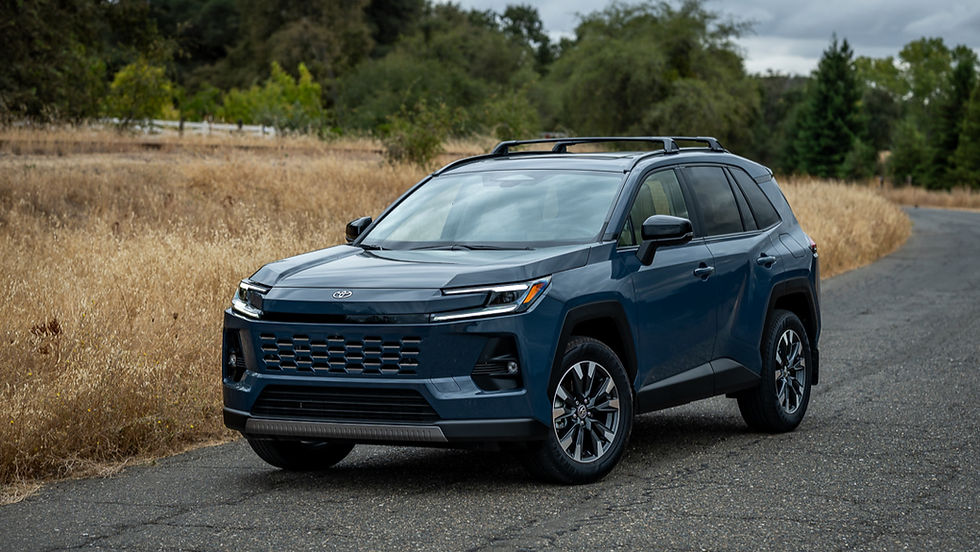
There are smaller annoyances, too. Proximity keyless entry only works on the front doors (competitors like the Toyota RAV4 offer it on all doors). You must wait for the power tailgate to fully close before locking the vehicle, otherwise it protests with an incessant warning beep.
Measuring 10.25-inches, the central touchscreen is adequately sized, but the underlying hardware shows its age with slow reflexes. The rotary controller can feel awkward depending on menu layout, and the abundance of awkwardly-placed buttons around the gear lever reinforces the car’s vintage. The backup and 360-degree cameras are also particularly poor in low light.

And then there’s a bizarre (and consistent) Mazda quirk: the wireless charging pad repeatedly triggers an iPhone to launch Apple Wallet. No other vehicle I’ve tested does this. In an era increasingly sensitive to digital privacy, that kind of glitch feels especially out of place.
It's all stacked against the CX-5
The CX-5 remains an enjoyable, near-entry-luxury crossover with genuine sporting ambition. But in 2025, it feels like a lame duck. I genuinely do like the CX-5, yet I like the CX-50 more — for its fresher design, panoramic sunroof, stronger towing capability, and some extra ability for unpaved roads. That broader capability makes it easier to recommend. However, it's impossible to ignore the pricing advantage the CX-5 carries to the tune of several thousand dollars.
The incoming 2026 CX-5 could change everything. Early images suggest a much larger central display and fewer physical controls — which may or may not be a mistake — but if Mazda successfully differentiates it from the CX-50 and adds hybrid power, the CX-5 could once again become the brand’s standout crossover.
For now, though, this final-year 2025 model feels like a very good car caught at the wrong moment.
2025 Mazda CX-5 Turbo Premium basic specifications
Price as-tested: $40,755
Engine & Performance
Engine: 2.5-liter turbocharged inline-4 (SKYACTIV-G)
Horsepower: 227 hp @ 5,000 rpm (regular fuel)
Torque: 310 lb-ft @ 2,000 rpm
Transmission: 6-speed automatic
Drivetrain: All-wheel drive (standard)
Towing Capacity: 2,000 lbs
Fuel Economy & Capacity
EPA Fuel Economy: 22 mpg city / 27 mpg highway / 24 mpg combined
Real World Economy: 22 MPG
Fuel Tank Capacity: 15 gallons
Recommended Fuel: Regular (87 octane; premium increases output to 256 hp)
Exterior Dimensions
Overall Length: 180 in
Width: 73 in
Height: 66 in
Wheelbase: 106 in
Ground Clearance: 8 in
Curb Weight: About 3,900 lbs
Interior Space
Passenger Volume: 104 cubic feet
Cargo Volume (behind rear seats): 30 cubic feet
Cargo Volume (rear seats folded): 59 cubic feet
Exterior Features (Turbo Premium)
19-inch alloy wheels
LED headlights and taillights
Power liftgate
Heated power side mirrors
Gloss black exterior accents
Interior & Comfort
Leather-trimmed seats
Heated front seats
Heated steering wheel
Dual-zone automatic climate control
Power-adjustable front seats (driver memory)
10.25-inch center display with rotary controller
Bose premium audio system
Wireless phone charger
Technology & Safety
Apple CarPlay and Android Auto
Blind Spot Monitoring
Rear Cross Traffic Alert
Lane Departure Warning with Lane Keep Assist
Adaptive Cruise Control with Stop & Go
Smart Brake Support
360-degree camera system
Warranty
Basic (Bumper-to-Bumper): 3 years / 36,000 miles
Powertrain: 5 years / 60,000 miles
Roadside Assistance: 3 years / 36,000 miles



I read the 2025 Mazda CX‑5 Turbo review and found it cool how the writer talked about the car’s smoother power, refined design, and better handling compared to past models while still keeping comfort for daily driving. It helped me understand how small changes in performance can make a big difference in real road feel. I remember a time I was so swamped with work that I even use online Statistics class help so I could finish assignments and still enjoy reading car reviews. That reminded me how good planning makes both study and hobbies more fun.