
2025 VW ID.4 Pro S review: Subtle improvements

Updated: Jan 28
Updates have arrived for the VW EV, but it's still trailing key rivals

2025 Volkswagen ID.4 Pro S review by The Road Beat
Words and pictures: Mitchell Weitzman
I haven’t enjoyed any stint with the ID.4 since its initial launch five years ago. Four previous examples have underwhelmed, especially when stacked against sometimes superb competition. The 2026 updates have certainly improved the ID.4 in top-spec Pro S trim, but there are still fundamental shortcomings that prevent it from being the objectively best EV in its fiercely-competed class.
Picks
Efficiency has never been the ID.4’s weak point—battery capacity has. A lack of kilowatts limited real-world range, and for years it showed. This Pro S now gets a marginally larger lithium pack, and paired with improved efficiency—3.2 mi/kWh during my week—the usable range jumps to a more respectable 240 miles. The previous Pro S struggled to crack 3 mi/kWh and 200 miles in total expectancy. Now, this more powerful AWD version even beats rivals like the Ioniq 5 Performance AWD on efficiency. Sure, 300 miles would be ideal, but approaching 250 while using fewer kilowatts is still progress.
Cabin materials have also improved. Faux-leather inserts now appear on the door panels, and there’s a noticeable increase in soft-touch surfaces throughout. Compared to the first ID.4 I tested back in spring 2021, this is a meaningful step toward luxury to match the asking price of $59,415. Is it class-leading? No. But it is visually and physically a nicer-made ID.4, at least in Pro S form.

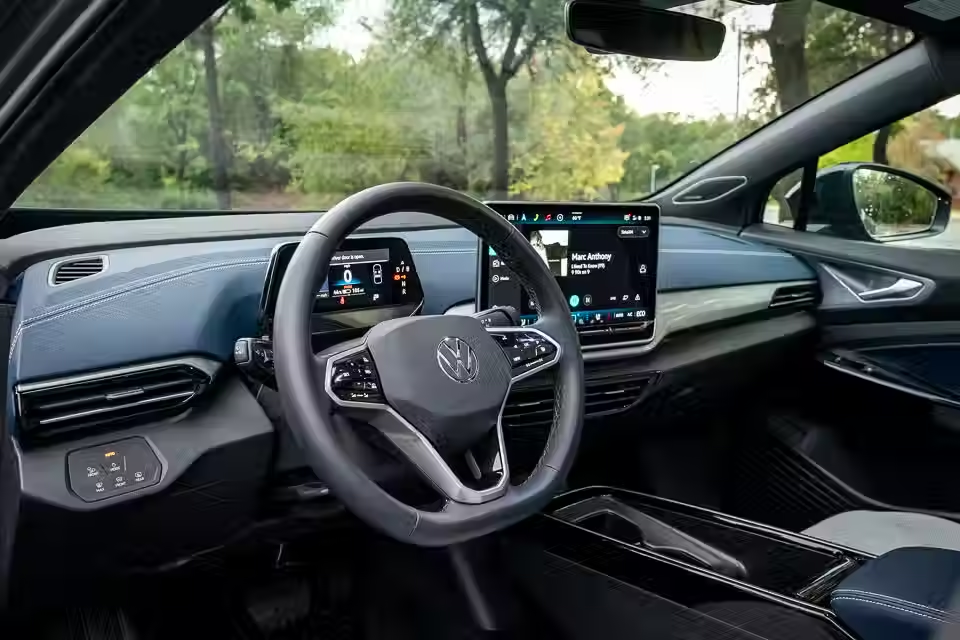
User interfaces were once a major weak point in the ID.4, plagued by slow loading and frozen pages. That finally seems resolved, as I experienced no meaningful lag, and the large central touchscreen is easy enough for entertainment and basic functions. The system remains deep and occasionally overwhelming, but at least it no longer locks up like before.
Performance is strong, as it should be with over 300 instant horsepower. Real-world pace is brisk and effortless, making freeway merges and passing a non-event. Traction is solid, and 0–60 mph arrives in just over five seconds—right on par with class rivals.

Back inside, the ID.4’s packaging continues to impress. It’s a physically large vehicle with generous passenger space and a roomy boot. Despite measuring under 190 inches long, the rear seats make it feel like a much bigger car.
Nicks
Even with clear improvements, many gray areas remain firmly (and cheaply) intact. Chief among them are the awful sliding volume and temperature controls beneath the central display. They’re fiddly, imprecise, and frustrating. Accessing the full climate menu also requires a very specific press, while the shortcut icons often lead to missed inputs and wrong selections. Technology like this is only a repeated and clear step backwards.

Materials may be better than before, but tactile controls are not. Interior door latches still feel wooden and oddly broken, while other components—like the center console—come across as cheap. I also can’t stand the tiny gauge cluster, which crams far too much information into far too little space.
It’s fortunate the efficiency and range are decent, because charging performance still lags behind competitors. The ID.4 is limited to 150 kW charging rather than taking the full advantage of 350 kW stations, translating to longer charging stops than many rivals. For those addicted to scrolling TikTok on their phones, they likely won't care.

Likewise, other brands have already natively integrated Tesla’s NACS port for native Tesla Supercharger access. VW is still relying on the SAE port, forcing owners to use adapters or depend on the notoriously unreliable Electrify America network and similar stations.
While rear-seat space is excellent, the front of the cabin suffers from a high dash and thick A-pillars that restrict forward visibility and make the car feel uneasy and unwieldy when navigating roads and parking lots. The centralized cupholder is another miss—bulbous, plasticky, and full of wasteful of space. Hyundai’s compact, sliding center console is a far better solution, feeling higher-quality while creating a larger and more flexible cabin.

Speed isn’t everything, and while the Pro S has punch, it lacks engagement elsewhere. Handling is uninspired, preferring straight lines over corners. The steering is vague and wooden, and the ride never quite settles, reacting firmly to trigger creaks and groans from the cabin plastics. You can drive it quickly on a twisty road, but there’s absolutely no joy in doing so.
Equipped as a top-spec ID.4 Pro S, MSRP now climbs to a frankly staggering $59,415 as-tested. For a Volkswagen crossover, that’s a tough sell—especially with federal incentives no longer propping up leases or purchases (and yes, you should still lease an EV).

A better ID.4 is not good enough
The improvements are real, and this is easily the best ID.4 I’ve tested. But viewed against today’s broader EV—and even hybrid—landscape, it feels old. It looks old, too. Worse, it’s riding on aging technology, and incremental updates and light refreshes aren’t even close to what VW needs to do to feel like it’s truly trying. In fact, it's been recently revealed that Volkswagen is skipping the 2026-model year for its ID.Buzz EV, a clear signal as to how they little care when it comes to their electric crop.
Volkswagen ID.4 Pro S image gallery



2025 VW ID.4 Pro S AWD — Specifications & Dimensions
As-tested price: $59,415
Power & Performance
Dual-motor all-wheel drive
335 horsepower (combined)
0–60 mph: ~5 seconds
Battery, Range & Charging
82 kWh battery (77 kWh usable)
EPA range: 263 miles
Real World range: ~240 miles
DC fast-charging peak: 150 kW
AC onboard charger: 11 kW
EPA efficiency: 102 MPGe combined
Real world efficiency: 3.2 miles / kWh
Exterior Dimensions
Length: 181 in
Wheelbase: 109 in
Width (without mirrors): 73 in
Width (with mirrors): 83 in
Height: 65 in
Ground clearance: 7 in
Turning diameter (curb-to-curb): 36 ft
Interior & Passenger Space
Seating capacity: 5
Passenger volume: 101 cu ft
Front headroom: 41 in
Rear headroom: 38 in
Front legroom: 41 in
Rear legroom: 38 in
Front shoulder room: 58 in
Rear shoulder room: 56 in
Cargo Capacity
Cargo volume (behind rear seats): 30 cu ft
Cargo volume (rear seats folded): 64 cu ft
Weight & Capability
Curb weight: 4,900 lb
Maximum towing capacity: 2,700 lb
Wheels & Tires
21-inch wheels (front and rear)
Front: 235/45R21
Rear: 255/40R21
Standard Warranty
New Vehicle Limited Warranty: 4 years / 50,000 miles
Powertrain Warranty: 4 years / 50,000 miles
High-Voltage Battery Warranty: 8 years / 100,000 miles
Roadside Assistance: 3 years / 36,000 miles — 24/7 emergency support.
Scheduled Maintenance: 2 years / 20,000 miles
Corrosion/Perforation: 7 years / 100,000 miles



Comments