
2026 Subaru Forester Wilderness review: Surprising fun

Updated: Mar 5
My first ever test of a Subaru caught me off guard by how much I liked it

2026 Subaru Forester Wilderness review with The Road Beat
Words and pictures by Mitchell Weitzman
For decades, Subaru has been associated with flannels, rescue dogs, progressive bumper stickers — and yes, lesbians. It’s one of the strangest and most persistent brand stereotypes in the car world. After a week with the Forester Wilderness, I realized something simpler: Subaru fans aren’t part of a cult. Rather, they just might have good taste.
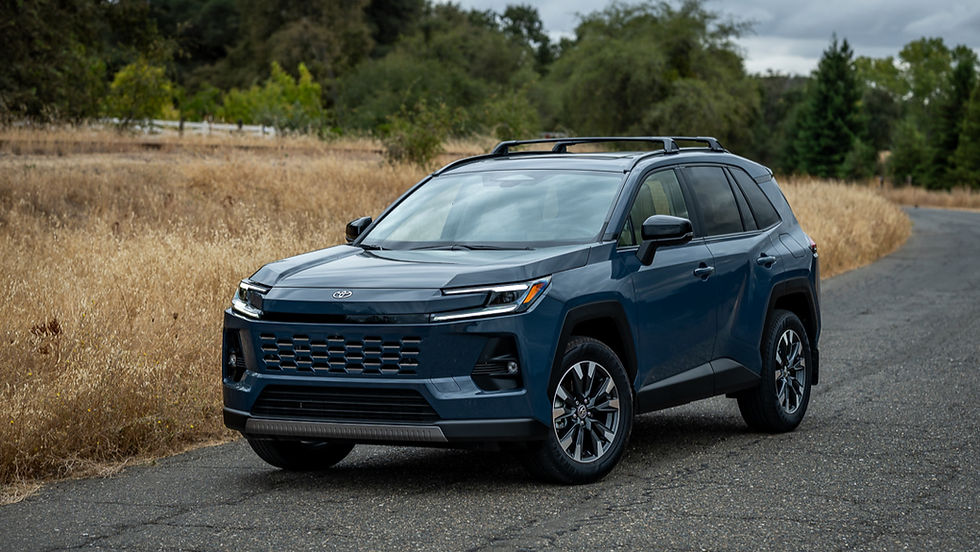
In Wilderness trim, the Forester is genuinely eye-catching. It’s not perfect, but it has a personality that quietly works its way under your skin — something many crossovers, particularly from Toyota, struggle to replicate. Focused on fun and encouraging you to wander that little farther, this Forester is a spirited crossover that makes you want to keep exploring.
Picks
Modern car design often leans into overstyled chaos. The Forester Wilderness isn’t entirely innocent of that trend, but here it feels cohesive rather than cluttered. The trademark plastic cladding around the fenders adds toughness instead of cheapness. Subtle gold accents, knobby all-terrain tires, and lifted proportions give it authentic presence.
It looks purposeful. And that's because it is, and multiple friends commented how nice this latest Forester appeared visually.

And because it’s a real-deal Subaru, it’s genuinely capable off-road. While I didn’t attempt anything Rubicon-level, the Forester handled several frankly appalling gravel roads with ease, gliding over loose surfaces with a calm and articulate demeanor. Ground clearance itself is a strong 9.3-inches, nearly a full inch more than what a new RAV4 Woodland Edition or a Mazda CX-50 offers while also dominating the approach and departure angle metrics, too.
A more revealing test came on a battered stretch of snaking tarmac just outside Georgetown, California — a road riddled with potholes, crests, and tight hairpins. A stiff modern sports car would feel fragile here, constantly wary of bottoming out or bending a wheel. In the Subaru, you simply carry speed and let the car and suspension do their job. It’s the kind of road where you start to feel like Colin McRae on a Monte Carlo rally Special Stage.

That compliance creates confidence, and even with thick all-terrain tires, the Forester encourages you to push harder than expected. It’s the classic “slow car fast” philosophy — but here it feels intentional. The suspension absorbs punishment without losing composure, and on smoother stretches the chassis reveals a balance that rivals what you’d expect from a Mazda in this class and enjoys a hasty pace. The steering is sharp and responsive, even if ultimate feedback is of course limited like most all new cars.
Then there’s Subaru’s horizontally opposed “boxer” four-cylinder. Output is modest — there’s no getting around that — but throttle response is crisp and immediate. Around town, it feels alert and eager enough, only feeling underpowered when you bury your foot and ask for more than it has to give - there isn't much extra.
What surprised me most is refinement. Unlike some coarse inline-fours that drone like unbalanced washing machines, the Subaru engine is relatively smooth and subdued. It never feels aggravated nor agricultural. For daily driving, that matters more than outright speed and an engine that plays in the background is much appreciated in a vehicle such as this.

Despite the rough roads — and sometimes enthusiastic pace — the Forester remained impressively solid. No squeaks. No rattles. The seats deserve praise too: comfortable for long stretches yet supportive enough when the road turns twisty.
I used to think calling a Subaru “fun” was just marketing optimism. Turns out, there’s substance behind the sentiment.
Nicks
Fuel economy is the most obvious casualty of the Forester and in Wilderness treatment. Despite its modest power output, the Forester returned just 22 mpg over a week of mixed driving. That’s noticeably behind several rivals and well below the hybrid alternatives from Mazda, Toyota, and Honda. Yes, the all-terrain tires play a role, but this is still a thirsty little engine.
The interior, while solidly assembled, leans heavily on hard plastics. At over $40,000, some materials don’t quite match the price tag — even if the overall construction feels durable and sorted. I like to oversized sunroof, but it's not quite panoramic in size and it's rather awkward and straining to fully open from the front seats.

A nearly 12-inch central touchscreen is another weak point. It’s visually busy at first glance, crowded with icons and information. More frustrating is its speed. Startup feels like waiting for a Windows 95 desktop to finish booting, and even once fully awake there’s a slight lag between inputs and responses. In a 2026 vehicle, that delay feels unnecessary. I never got lost in the infotainment at least, so despite the stuffed nature of it, it's at least easy to use find your way around it. Also, the reverse camera isn't great at night.
A welcome cure to the common crossover
I didn’t approach my first Subaru test with particularly high expectations, and that may have worked in its favor. I left impressed — and curious to try more. The Forester Wilderness isn’t a novelty for outdoorsy caricatures. It’s a genuinely capable crossover with character, something increasingly rare in this segment. It encourages you to turn down the rough road just to see what’s there.
As rivals like the RAV4 and Cherokee move further toward hybrid-only lineups boasting near-40 mpg efficiency, the Forester Wilderness gives up meaningful ground in fuel economy. That’s the trade-off. And while Subaru does offer a hybrid Forester of their own, it's sadly not compatible in the cool Wilderness trim.
Subaru, if you’re listening: give us a Forester Wilderness Hybrid.


2026 Subaru Forester Wilderness – Key Specifications
Basic Info
Body type: AWD compact SUV / 5-door wagon
Seating: 5 passengers
Price as-tested: $42,430
Engine & Performance
Engine: 2.5-liter naturally aspirated flat 4 'boxer'
Horsepower: 180 hp @ 5800 rpm
Torque: 178 lb-ft @ 3700 rpm
Transmission: Continuously variable automatic (CVT)
Drivetrain: Symmetrical all-wheel drive
Towing Capacity: ~3,500 lbs
0–60 mph: ~8.5 seconds
Fuel Economy & Fuel
Fuel Economy: 24 mpg city / 28 mpg highway / 26 combined
Real World Economy: 22.5 MPG
Fuel Type: Regular unleaded
Fuel Tank Capacity: ~17 gallons
Dimensions
Curb Weight: 3,675 lbs
Length: 183 in
Width (without mirrors): 72 in
Height: 69 in
Wheelbase: 105 in
Ground Clearance: 9.3 in
Turning Diameter: ~35 ft
Cargo Volume (seats up): 28 cu ft
Cargo Volume (seats down): 69 cu ft
Off-Road Capability
Approach Angle: ~24°
Departure Angle: ~26°
Break-over Angle: ~21°
All-Terrain Tires: Standard Yokohama A/T 235/60R17
Underbody Protection: Standard skid plates
Warranty
Basic Warranty: 3 years / 36,000 miles
Powertrain Warranty: 5 years / 60,000 miles
Roadside Assistance: 3 years / 36,000 miles
Corrosion Perforation: 5 years / unlimited miles
Other Standard Features (Summary)
Standard Symmetrical AWD with off-road-ready X-Mode settings
17-inch alloy wheels with all-terrain tires
Power liftgate
StarTex durable upholstery
12-inch touchscreen with Apple CarPlay / Android Auto
EyeSight driver-assist tech suite
Front underbody protection & rugged trim accents



The review of the 2026 Subaru Forester Wilderness was interesting because it shows how a normal SUV can feel more fun and capable off road, with rugged parts, good ground clearance, and confidence on rough trails. I liked how the writer described both the comfort on the road and the toughness in nature. When I read it during a busy week of classes, I remember feeling overwhelmed with tests and at one point I even wanted online Nursing exam help so I could finish my work and still enjoy reading about cars. It reminded me that balance between study and hobbies keeps things fun.