
2026 Subaru Solterra review: The EV Subaru should've built from the start

The second-generation Solterra is a massive improvement

2026 Subaru Solterra review by The Road Beat
Words and pictures: Mitchell Weitzman
To say that the first version of the Subaru Solterra (and its Toyota bZ4X identical twin) was a dud is not an exaggeration. Thankfully, Subaru has made the Solterra better in virtually every measurable way. Most impressively, it also represents genuinely good value compared with much of its electric competition. This isn't the crossover that'll give your life a kick of caffeine, but as an everyday EV on the somewhat affordable spectrum, it works remarkably well.
Picks
Originally, the Solterra couldn't come close to its accomplished peers when it came to performance or driving range. Both crucial shortcomings have been remedied, with AWD output increasing by roughly 50 percent and total driving range climbing by nearly the same amount. The last 2023 bZ4X I tested—mechanically identical to the prior Solterra—could barely reach 200 miles on a full charge. This new version? My real-world estimate was around 280 miles, going from pathetic to good.
More impressive still is the actual efficiency. At 4.0 miles per kWh (the closest equivalent to MPG for electrics), this is comfortably the most efficient EV I've tested. Multiply that by the roughly 71 kWh of usable battery capacity and you arrive at a theoretical 280-mile range—almost exactly what I observed in the real world. The previous model averaged closer to 3 miles per kWh, making this improvement immediately noticeable in everyday driving.

Not only is it dramatically more efficient, but output for this basic Premium dual-motor AWD model has jumped from a merely adequate 215 horsepower to 233, and the added urgency is surprisingly noticeable in the real world. And if do you want more, there's an XT model now boasting a legitimately rapid 338. An extra 20 or 30 horsepower would've been welcome, but an increase of more than 100 shows just how outdated the previous drivetrain options already were. As such, 0-60 MPH now happens in as little as 4.5 seconds on an XT—if you want it to.
The interior has been simplified as well, and it's better for it. Build quality and major touch points remain sturdy, if never luxurious. Yet the Solterra exhibited no rattles, even on my battered neighborhood streets, and remained quiet enough at 70 MPH on the highway. In fact, it's an exceptionally calm cruiser, making it an easy commuter and highway companion without any of the vocally strained four-cylinder nastiness you get in many gasoline crossovers. The seats also proved comfortable and surprisingly supportive through turns.

Competence is high on backroads, and on the recently repaved Green Valley Road near me, you can carry a suicidal pace if desired, such is the grip available with very little effort. However, it isn't engaging or particularly fun, even if the chassis itself is impressively capable. It's a shame there's almost no steering feedback, because this platform could've served as the basis for something truly ridiculous—similar to what Hyundai accomplished with the Ioniq 5N.
The Solterra now uses a native NACS charge port, allowing direct access to Tesla Superchargers without an adapter. CCS fast chargers remain compatible with the appropriate adapter, but Tesla's network continues to be the most available and reliable charging infrastructure in the country, making this a meaningful quality-of-life improvement.

At roughly $40,000 as-tested, the Solterra significantly undercuts a comparably equipped Hyundai Ioniq 5 AWD while landing almost exactly alongside an entry-level AWD Tesla Model Y before a single option is even considered. And for the more basic model, it has all the basic ammenities and seats that aren't cheap cloth even.
Nicks
Mechanically it's massively improved, but the exterior has received only mild updates and remains one of the blandest automotive designs currently on sale. It's difficult to judge a car purely on its appearance, but this thing does absolutely nothing for me and still resembles the most generic AI-designed box imaginable, albeit with an overly large Subaru badge tacked-on at the front.

Even with the welcome addition of NACS, DC fast charging still peaks at 150 kW. That's perfectly usable, but competitors capable of charging at over 200 kW will generally spend less time plugged in and stationary waiting.
Inside is a squared-off steering wheel that's perfectly acceptable while driving, but becomes awkward during parking maneuvers or any kind of three-point turn. The unusual shape is necessary, however, because a conventional round wheel would partially block the small and distant digital gauge cluster (the Toyota suffers badly from this).

I also found the active driver-assistance systems a little too eager to intervene for my liking, while the adaptive cruise control didn't always maintain a perfectly steady speed on highways with frequent elevation changes. And speaking of driver-assistance, there is literally nothing here comparable to the advanced tech available on Teslas, so if that's a must0have you will need to look to Elon's company and be ready to spend a bit extra still.
A complete, but unexciting package
As an electric crossover, the Solterra gets an awful lot right while presenting itself as excellent value against similarly sized rivals. Tesla still enjoys a significant advantage thanks to its mature ecosystem and features available like Full Self-Driving, but Subaru has finally addressed the areas where the original Solterra fell well short.
For buyers shopping the midsize EV crossover segment, the Solterra suddenly deserves to be near the top of the shortlist. I still wish it looked even remotely exciting—and it's a shame the smaller Uncharted is the more attractive Subaru EV—but if styling doesn't matter, the Solterra has quietly become one of the better values in the segment. That's a recommendation I never expected to give the original.


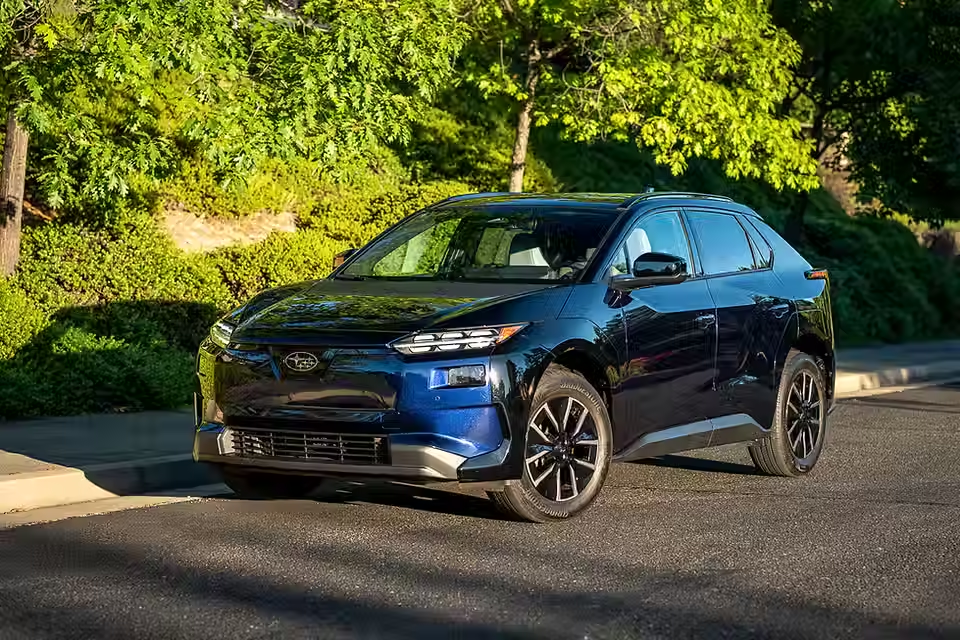

2026 Subaru Solterra Premium AWD
Price as-tested: About $40,000
Powertrain
Dual permanent-magnet AC electric motors (front and rear)
Total output: 233 horsepower to 338 (XT)
Single-speed automatic transmission
Standard all-wheel drive (Symmetrical AWD with X-MODE)
Battery & Charging
Battery capacity (gross): 74.7 kWh
Usable battery capacity: 71 kWh
EPA estimated range: 285 miles
Maximum DC fast charging: 150 kW
10-80% DC fast charge: Approximately 35 minutes
Charge port: NACS (North American Charging Standard)
Efficiency
EPA efficiency: 114 MPGe combined
Observed efficiency: 4 miles/kWh
Chassis
Front suspension: MacPherson strut
Rear suspension: Double wishbone
Front brakes: Ventilated discs
Rear brakes: Ventilated discs
Wheels: 18-inch alloy
Tires: 235/60R18
Dimensions
Wheelbase: 112 inches
Length: 185 inches
Width: 73 inches
Height: 65 inches
Ground clearance: 8 inches
Curb weight: 4,500 lbs
Utility
Seating: 5
Cargo capacity (behind second row): 26 cu ft
Maximum cargo capacity: 64 cu ft
Warranty
Basic: 3 years / 36,000 miles
Powertrain: 5 years / 60,000 miles
Battery electric system: 8 years / 100,000 miles
Corrosion perforation: 5 years / Unlimited miles
Roadside assistance: 3 years / 36,000 miles



Comments